When most people talk about multi-region architectures, they immediately jump to diagrams full of globally distributed databases, active-active replication, service meshes, and enough complexity to require a dedicated platform team.
That’s not the reality for most e-commerce companies.
My responsibility is managing the infrastructure that powers our online storefronts while also leading development efforts, reviewing code, managing deployments, and supporting multiple business initiatives. Every architectural decision has to balance reliability, performance, operational complexity, and cost.
As we expanded our presence beyond the United States and continued investing in our Canadian storefront, I started evaluating what a practical multi-region architecture should actually look like for an e-commerce platform.
The goal wasn’t to build the most impressive AWS diagram possible.
The goal was to improve:
- Availability
- Fault tolerance
- Time-to-first-byte (TTFB)
- Peak traffic handling
- Geographic proximity for customers
While keeping the system maintainable by a relatively small engineering team.
This article walks through the architectural decisions, tradeoffs, and implementation approach I recommend for most mid-sized e-commerce organizations.
The Problem With Traditional Single-Region E-Commerce#
Most AWS-hosted Magento environments follow a familiar pattern:
| |
This works well until you begin encountering issues such as:
Regional Failures#
Even highly available AWS services occasionally experience disruptions.
A full regional outage is rare, but partial service failures happen more often than many teams realize.
If everything lives in a single AWS region, your blast radius becomes:
| |
Not ideal when every minute of downtime directly impacts revenue.
International Customers#
As we expanded our Canadian presence, latency became a bigger concern.
Even if Cloudflare is caching most static content, dynamic requests still need to travel back to the origin infrastructure.
This becomes especially noticeable for:
- Product searches
- Cart operations
- Checkout workflows
- Customer account pages
- Personalized content
Reducing geographic distance between customers and compute resources can have a measurable impact on perceived performance.
Traffic Spikes#
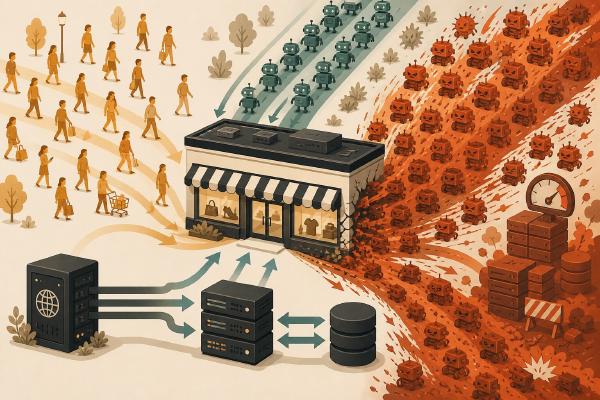
E-commerce traffic is rarely consistent.
Traffic surges can come from:
- Marketing campaigns
- New product launches
- Seasonal promotions
- Email campaigns
- Viral social media exposure
A single region can scale significantly, but distributing traffic across regions creates additional headroom while reducing localized bottlenecks.
Why We Didn’t Pursue Active-Active Everything#
Whenever multi-region discussions begin, someone inevitably proposes:
Let’s make everything active-active.
In theory, this sounds fantastic.
In practice, it introduces significant challenges:
- Database conflict resolution
- Inventory synchronization
- Order consistency
- Session replication
- Increased operational complexity
- More difficult troubleshooting
For Magento specifically, active-active databases can quickly become a nightmare.
Inventory counts, orders, customer accounts, and payment transactions all require strong consistency.
The complexity often outweighs the benefits.
For most e-commerce companies, active-active is solving a problem they don’t actually have.
The Architecture I Prefer#
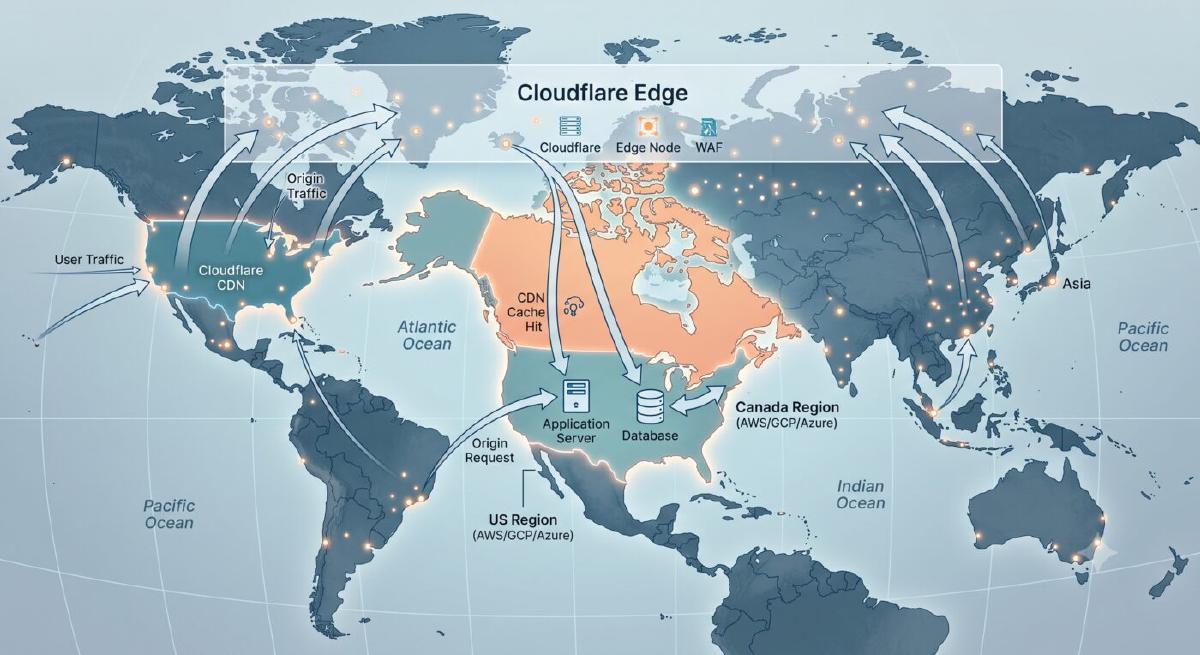
Instead of active-active databases, I favor a hybrid approach:
| |
This provides:
- Multi-region compute
- Regional failover capability
- Improved customer proximity
- Simpler data consistency model
- Lower operational burden
Without introducing distributed database complexity.
Frontend Architecture#
One of the biggest improvements we made was separating frontend concerns from Magento.
Our storefront utilizes Next.js rather than relying solely on Magento rendering.
This provides several advantages:
- Faster page loads
- Better caching opportunities
- Reduced Magento workload
- Improved scalability
The frontend runs in ECS Fargate behind an Application Load Balancer.
| |
Fargate allows horizontal scaling without worrying about underlying server management.
During traffic spikes:
| |
AWS handles provisioning automatically.
For stateless frontend services, this is an excellent fit.
Backend Architecture#
Magento presents a different challenge.
Unlike the frontend, Magento often requires:
- Custom extensions
- Local filesystem dependencies
- Third-party integrations
- Legacy application assumptions
For this reason, I maintain Magento on EC2 using pre-baked AMIs.
| |
Every AMI contains:
- Application code
- Required packages
- PHP configuration
- Monitoring agents
- Deployment dependencies
This approach provides:
- Faster scaling events
- Consistent deployments
- Reduced configuration drift
Instead of provisioning servers during scale-out events, new instances launch already configured.
Breaking Magento Dependencies#
One of the most important architectural decisions wasn’t infrastructure related at all.
It was reducing dependence on Magento itself.
Historically, many storefront requests flowed directly through Magento GraphQL and REST endpoints.
As traffic grows, this becomes problematic.
Magento is extremely capable, but it’s not always the most efficient system for every request.
We began extracting high-volume functionality into dedicated services:
| |
Benefits include:
- Reduced Magento load
- Better cacheability
- Independent scaling
- Improved response times
- Easier regional deployment
This becomes even more valuable in a multi-region architecture because stateless services are significantly easier to replicate globally than a monolithic application.
Database Strategy#
The database is where many multi-region architectures become unnecessarily complicated.
My preference is straightforward:
Primary Region#
| |
Handles:
- Orders
- Checkout
- Inventory updates
- Customer accounts
- Administrative operations
Secondary Region#
| |
Handles:
- Read-heavy workloads
- Reporting
- Regional failover preparation
Benefits include:
- Reduced read pressure
- Geographic redundancy
- Faster recovery options
- Lower complexity
This preserves a single source of truth while still gaining many multi-region advantages.
Traffic Routing#
Cloudflare becomes increasingly valuable in a multi-region design.
Instead of exposing AWS directly:
| |
Cloudflare provides:
- Global Anycast routing
- Edge caching
- DDoS protection
- WAF controls
- Health-based failover
In many cases, Cloudflare can improve user experience more dramatically than adding additional AWS regions.
I often recommend maximizing edge caching opportunities before introducing complex multi-region database architectures.
Handling Regional Failures#
The objective isn’t necessarily zero downtime.
The objective is minimizing recovery time while maintaining operational sanity.
If the primary region experiences issues:
| |
Recovery procedures become predictable.
Because infrastructure already exists in the secondary region, failover becomes an operational event rather than a disaster recovery project.
The Cost Reality#
Multi-region infrastructure is not free.
You’ll pay for:
- Additional compute
- Cross-region data transfer
- Read replicas
- Load balancers
- Monitoring
- Storage replication
The question isn’t:
Can we build it?
The question is:
Does the business benefit justify the cost?
For most e-commerce organizations, the answer is yes once revenue reaches a point where a regional outage becomes more expensive than maintaining standby infrastructure.
Lessons Learned#
After spending years scaling e-commerce infrastructure, I’ve found that the most successful architectures are rarely the most complicated.
A practical multi-region strategy should:
- Improve availability
- Improve customer experience
- Scale predictably
- Remain understandable
- Be operable by your existing team
The biggest gains often come from:
- Separating frontend and backend workloads
- Reducing dependence on Magento
- Leveraging Cloudflare aggressively
- Using auto-scaling everywhere possible
- Maintaining a single authoritative database
- Adding regional redundancy where it provides measurable value
The temptation is always to chase the most advanced architecture.
In reality, the best architecture is the one your team can confidently operate at 2 AM during an outage.
For most e-commerce companies, that means building a resilient multi-region platform—not a distributed systems research project.